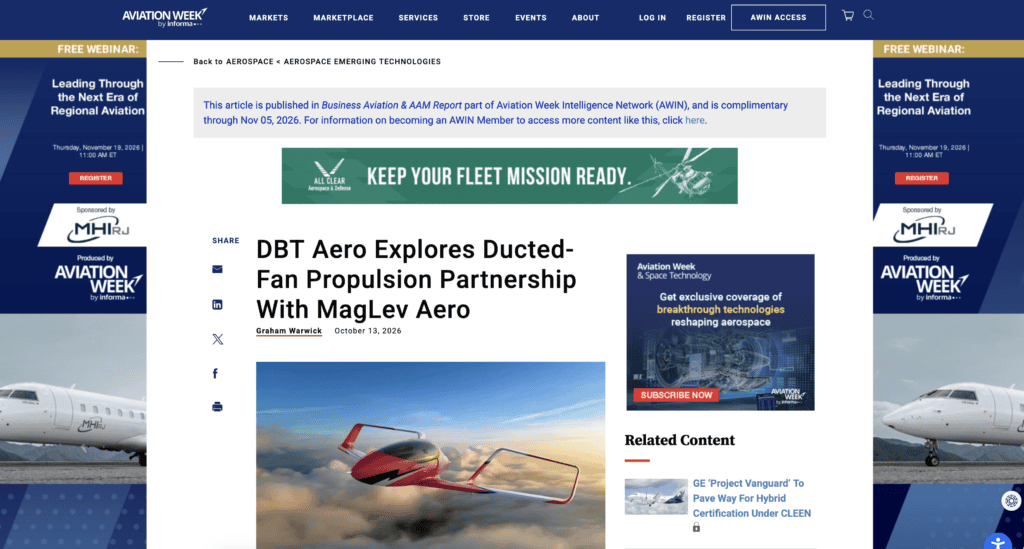
Companies sign MOU to evaluate MagLev Aero’s HyperDrive™ electric ducted-fan (EDF) propulsion across DBT Aero’s aircraft family and plan testing on a DBT Aero sub-scale demonstrator
BOSTON — October 1, 2026 — MagLev Aero Inc., developer of the HyperDrive™ rim-driven electric ducted-fan (EDF) propulsion system, and DBT Aero Inc., a developer of a highly efficient, clean-sheet family of aircraft, announced they have signed a memorandum of understanding (MOU) to evaluate integrating HyperDrive™ with DBT Aero aircraft. The companies plan to test HyperDrive™ on a DBT Aero sub-scale demonstrator, pairing MagLev Aero’s magnetic-levitation propulsion with DBT Aero’s laminar-flow airframe.
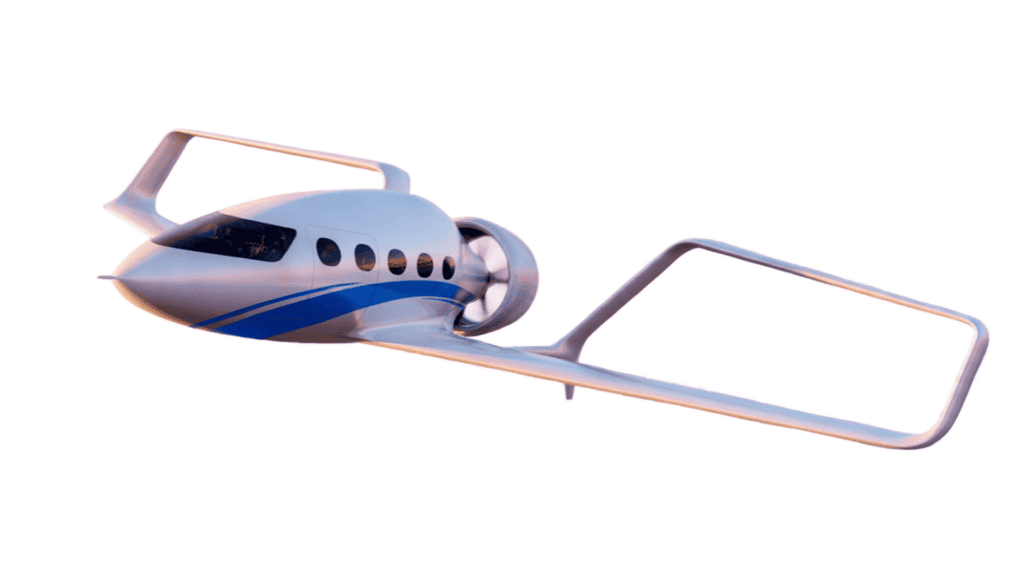
The companies are partnering because each technology is expected to make the other perform better. DBT Aero’s laminar-flow fuselage delivers smooth air to a centerline fan, which is expected to improve the fan’s efficiency and thrust. In turn, the fan’s suction helps control the fuselage boundary layer and reduce drag. The airframe helps the fan, and the fan helps the airframe.
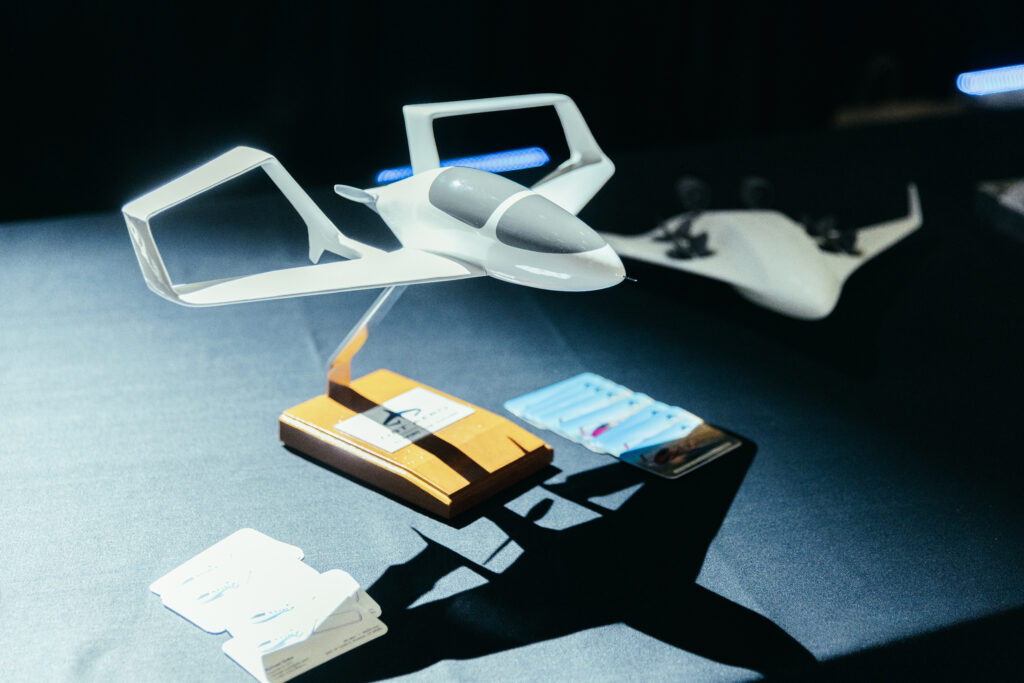
The companies presented their collaboration on September 30 at “The Future of Flight, Demonstrated,” an invitation-only technology showcase and propulsion demonstration of MagLev Aero’s HyperDrive™ rim-driven EDF technology in Boston. The exclusive event brought together leaders from defense, government, industry, and the investment community, and followed MagLev Aero’s September 25 announcement of two DARPA contracts to advance HyperDrive™ toward full-scale flight demonstration.
DBT Aero’s design integrates three technologies into a single system: full-airframe Natural Laminar Flow, the patented Double Box Tail geometry, and an integrated propulsion architecture. Because DBT Aero’s laminar-flow strategy is designed to keep propwash off the wing, its aircraft place the propulsor at the rear of the fuselage. The architecture has flown on four aircraft across four scales, from sub-scale unmanned aircraft to a 32-foot manned demonstrator.
In his presentation, DBT Aero Founder and CEO Michael Duke noted that a ducted fan reduces losses compared with an open propeller, offers advantages during takeoff and climb, and can reduce takeoff noise compared with an unshielded propeller.
MagLev Aero’s HyperDrive™ rim-driven EDF shows what is possible when the propulsion system is integrated with the airframe geometry, which is expected to enhance the performance of both.
“Many electric aircraft programs start with an existing airplane and try to electrify it. It’s like electrifying a 1957 Chevy,” said Duke. “We went the other way. Our aircraft was designed around a single propulsor at the rear of the fuselage long before a practical electric ducted fan existed. MagLev Aero builds propulsion. We build airframes. Now we find out what they can do together.”
“DBT Aero has developed something propulsion engineers rarely encounter: an aircraft architecture designed from the outset around an aft-mounted propulsor,” said Ian Randall, Co-Founder and CEO of MagLev Aero. “That gives us the opportunity to evaluate our technology in an installation where the airframe and propulsion system can be considered together rather than treated as separate systems. We look forward to putting that combination through the engineering process.”
Under the MOU, MagLev Aero and DBT Aero will evaluate the propulsion technology across DBT Aero’s aircraft family, spanning unmanned systems to crewed aircraft. The companies also plan to test MagLev Aero’s HyperDrive™ on a DBT Aero sub-scale demonstrator. The program marks a future stage in DBT Aero’s propulsion roadmap and does not alter the propulsion plan for the company’s first production aircraft. The two-seat DBT-2LX is being developed for FAA certification under the MOSAIC rule and will be powered by a conventional engine and propeller.
In summary, MagLev Aero and DBT Aero will jointly evaluate HyperDrive™ across DBT Aero’s aircraft family and plan to test it on a DBT Aero sub-scale demonstrator to measure how the laminar-flow airframe and the centerline fan improve each other’s efficiency. The collaboration supports DBT Aero’s longer-term propulsion roadmap; the DBT-2LX remains on its conventional-engine certification path.



About MagLev Aero
MagLev Aero is a Boston-based company developing the MagLev HyperDrive™ propulsion platform for the next generation of drones and advanced air vehicles. Backed by Breakthrough Energy Ventures and Material Impact, with 44 issued patents, its rim-driven ducted fan architecture leverages patented magnetic-levitation technology to deliver more thrust for less power. MagLev Aero holds two DARPA contracts supporting HyperDrive™’s advance toward full-scale flight demonstration. Learn more at maglevaero.com.
About DBT Aero DBT Aero Inc., headquartered in Salt Lake City, Utah, is developing a family of clean-sheet aircraft, from unmanned systems to regional aircraft, integrating full-airframe Natural Laminar Flow, the patented Double Box Tail geometry, and an integrated propulsion architecture, starting with the two-seat DBT-2LX. DBT Aero’s aircraft architecture has flown on four aircraft at four scales, from sub-scale unmanned aircraft to a 32-foot manned demonstrator. dbt.aero
This article was reported in AIN Magazine