
DBT Aero is Redefining Regional Aviation
BY BEN NEIVERT, CHIEF OF STAFF, DBT AERO
I have been a pilot since I was a teenager. I have always loved to travel. Recently, more of my travel has been on regional aircraft, and I have begun to understand the challenges regional carriers face in moving people and freight while making even a small profit.
The Tyranny of Distance: Why Regional Aviation is Struggling
For decades, the “tyranny of distance” — a phrase historically used to describe the isolating vastness of remote regions — has severely constrained economic and social connectivity. While major urban centers enjoy frequent, competitive, and relatively affordable air travel, regional and remote communities often face a stark choice: endure long, inefficient ground travel or pay exorbitant fares for limited flights.
The Lifeline of Remote Communities
Regional carriers are a vital lifeline for the communities they serve. Around the world, these communities rely on affordable air travel to connect to population and commercial centers. It is not just about tourism or visiting family; it is about access to specialized healthcare, essential government services, and the timely movement of premium freight. When a regional route is cut or becomes too expensive, the economic pulse of that community begins to slow.
The Economic Trap of Aging Fleets
The root of the problem lies in the unforgiving economics of today’s regional aircraft. Today’s operators are caught in a financial trap. To keep upfront capital costs down, they must rely on aging fleets of smaller regional turboprops. While these aircraft are inexpensive to acquire, they are notoriously expensive to operate.
Maintenance costs rise as airframes age, and older engine technologies burn more fuel per seat-mile than modern jets. Furthermore, operators must choose between a turboprop aircraft—with its slower speeds, smaller and noisier cabin, higher vibration, and higher operating costs as the aircraft ages—or a jet aircraft. Jets are often simply too large to operate profitably on thinner routes, yet too small to achieve the economies of scale seen on trunk routes between major cities. Operators are forced to choose between flying older turboprops, flying half-empty planes, or reducing frequency to a point where the service becomes inconvenient for travelers.
The Passenger Experience Deficit
Beyond the balance sheet, the human element matters. Attracting and retaining customers on regional routes is an uphill battle, largely because of the passenger experience. Regional turboprop aircraft are notorious for cramped, noisy cabins. The persistent drone of the engines and the vibration throughout the cabin make for a fatiguing journey. Additionally, limited in-cabin baggage space often forces passengers to gate-check bags, adding friction and delays to what should be a quick, seamless trip. Until the comfort gap between mainline and regional aircraft is closed, convincing travelers to fly rather than drive will remain a significant challenge.
Identifying the Solution: The DBT Aero Design Trilogy
While the challenges facing regional aviation are deeply entrenched, a new generation of aircraft design promises to rewrite the industry’s economics. DBT Aero’s upcoming family of Double Box Tail (DBT) aircraft is based on a design trilogy that directly addresses the inefficiencies of current fleets. By combining three distinct technological advancements, this approach promises an aircraft that is faster, cheaper to operate, and significantly more comfortable.
The Double Box Tail (DBT)
The most visually striking feature of this new design is the Double Box Tail. Unlike traditional empennage (tail) designs, the DBT Aero configuration provides exceptional aerodynamic efficiency and structural strength. This design reduces the aircraft’s overall weight while minimizing induced drag—the resistance created by the wings and tail as they generate lift. The result is a highly stable aircraft that requires less energy to maintain flight, translating directly into fuel savings and extended range.
Natural Laminar Flow
The second pillar of the design is Natural Laminar Flow (NLF) across the wings and fuselage. In traditional aircraft, air quickly becomes turbulent as it passes over the surfaces, which dramatically increases drag. NLF technology shapes the aircraft’s exterior so that the air remains smooth and attached to the surface for as long as possible. By significantly reducing skin friction drag, the aircraft can slip through the air more efficiently, allowing for higher speeds without a corresponding increase in fuel burn.
Hybrid-Electric Propulsion
The final element of the trilogy is an integrated, hybrid-electric propulsion system. By combining traditional turbine power with electric motors, the aircraft can optimize its power output for different phases of flight. For example, a combination of turbine and electric power can boost takeoff and climb, while the electric-only system takes over during the more efficient cruise phase. In addition, the ducted fan propulsor can generate power during descent to charge the battery.
This system not only slashes fuel consumption and emissions but also dramatically reduces the noise and vibration typically associated with regional turboprops. Critically, the turbine provides the onboard charging needed to support fast turnarounds at regional airports that currently lack electric charging infrastructure.
Implementation: Rewriting the Economics of Regional Travel
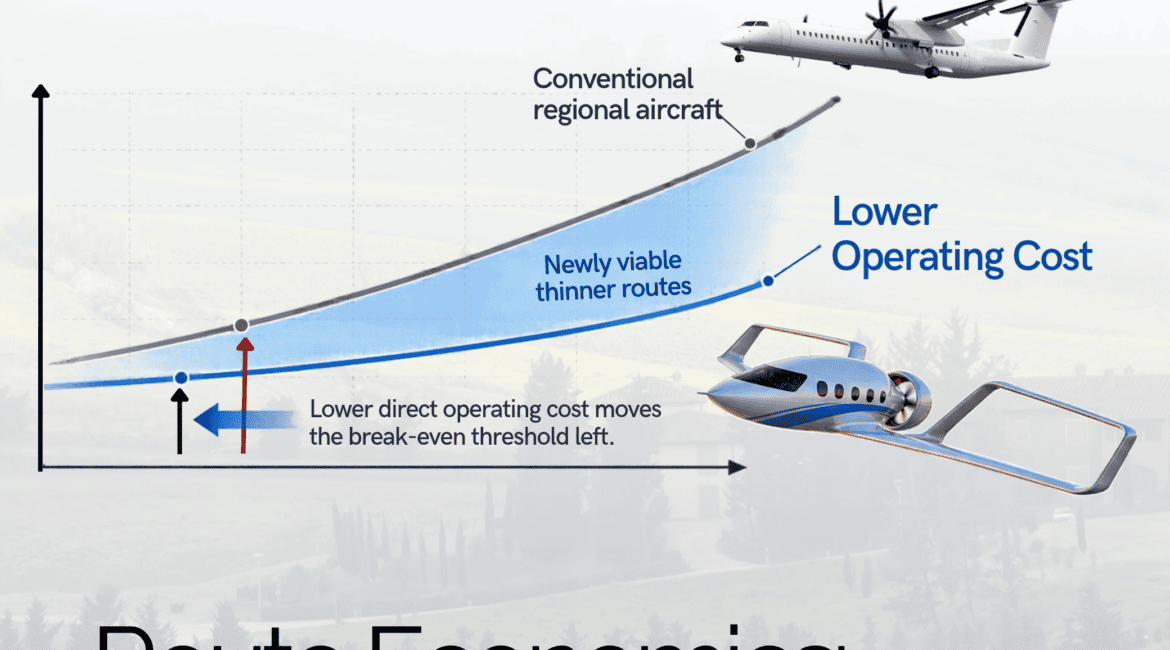
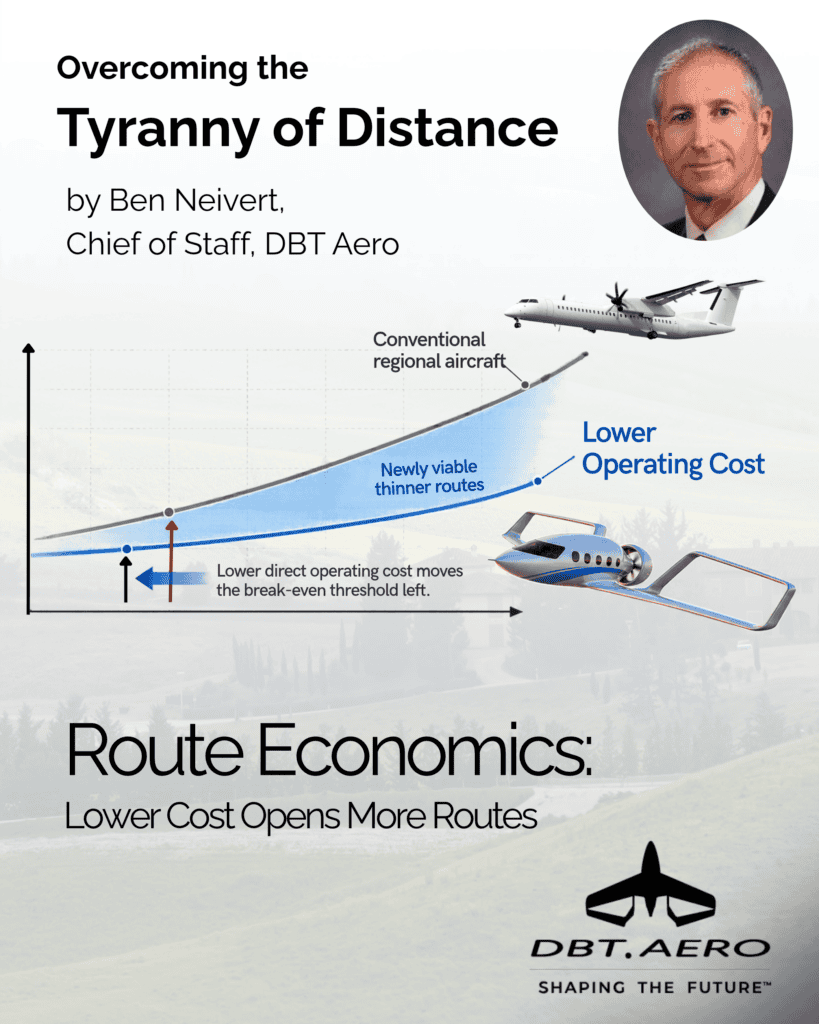
The true test of any new aviation technology is not how it performs in a wind tunnel, but how it performs on the balance sheet and on the tarmac. Integrating the Double Box Tail, Natural Laminar Flow, and integrated hybrid-electric propulsion is not just an academic exercise; it is a practical solution designed to cut operating costs in half while maintaining or exceeding current speeds.
A New Value Proposition for Operators
For regional carriers, the math is compelling. By halving direct operating costs—primarily through reduced fuel burn and lower maintenance requirements—operators can finally turn a profit on thinner routes that were previously not viable. This efficiency enables a fundamental shift in strategy: instead of flying large, half-empty aircraft a few times a week, carriers can fly smaller, full aircraft more frequently. This increase in frequency is exactly what business travelers and freight forwarders need to connect regional hubs with major commercial centers.
Transforming the Passenger Experience
The benefits of this new design extend directly to the passenger cabin. An additional advantage of the DBT Aero design is a wider fuselage, meaning more shoulder room and larger overhead bins for carry-on luggage. Furthermore, the hybrid-electric propulsion system significantly dampens the noise and vibration that currently plague regional turboprops. The result is a quiet, jet-like cabin experience that makes regional flying a viable, comfortable choice rather than a noisy, cramped necessity.
The Future of Connectivity
Ultimately, the promise of this technology is about more than the aircraft itself; it is about the communities it will serve. By bridging the gap between high operating costs and the need for affordable travel, DBT Aero’s new breed of aircraft can finally overcome the “tyranny of distance.” Reliable, daily connections can transform a remote town into a viable hub for new businesses, specialized healthcare, and tourism. The future of regional aviation is not just about flying more efficiently; it is about keeping the world’s most isolated communities connected to the global economy.
About DBT Aero
Founded in 2019, DBT Aero develops aircraft and aerodynamic technologies centered on its patented Double Box Tail configuration. The company’s work includes the Swyft family of unmanned aircraft and the manned Synergy Prime proof of concept, which is undergoing ground and flight testing under an FAA Special Airworthiness Certificate. DBT Aero’s mission is to make air travel and transport safer, quieter, more affordable, and more sustainable.
Contact DBT Aero
Learn more at dbt.aero. For general inquiries, email [email protected] or call +1 801-310-2828.
